
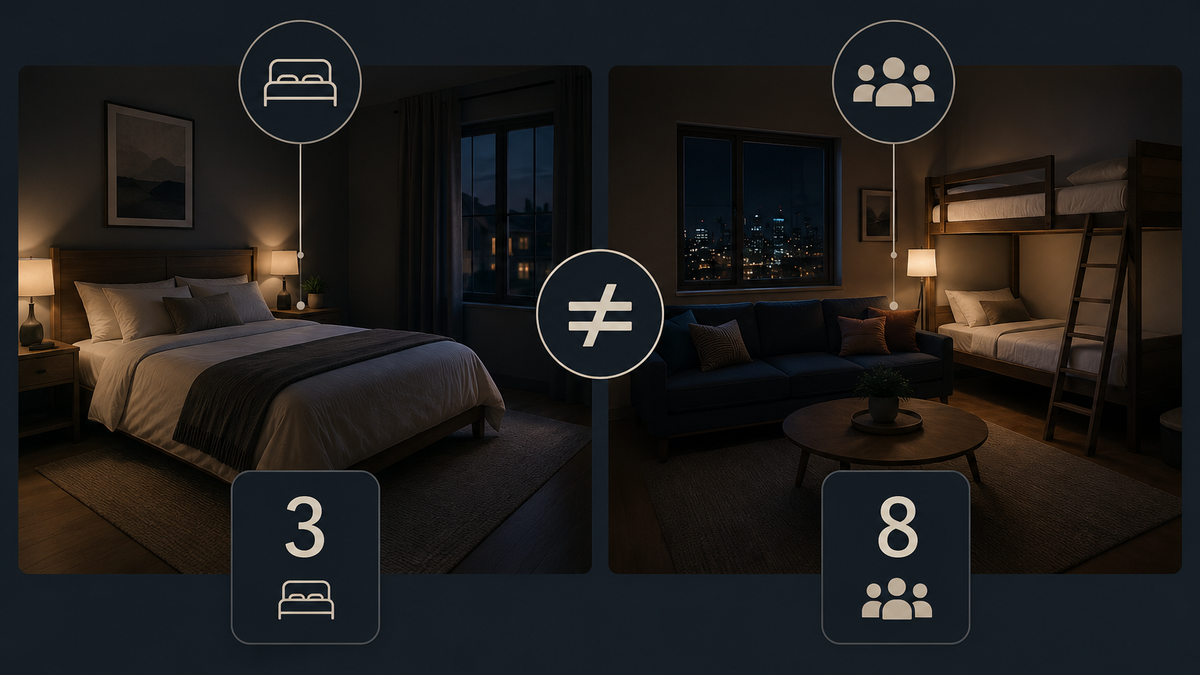
Guest Capacity vs. Bedroom Count: Why They're Not the Same Signal
Two properties with the same bedroom count can sleep a different number of guests — and that gap is where a bedroom-only market read goes wrong.
Bedroom count and guest capacity get treated as the same variable. A market analysis filtered by bedrooms alone is quietly assuming they move together. They don't always, and the gap between them is exactly where a segment can outperform or underperform what the bedroom count alone would suggest.
What bedroom count actually predicts
AirROI's April 2026 analysis of over 21,000 cabin listings across ten mountain markets found something specific about bedroom count: occupancy barely moves as bedroom count rises, and the revenue gap is driven almost entirely by rate. In their Gatlinburg data, a two-bedroom cabin averaged $276 a night at 48% occupancy for about $36,000 in annual revenue. A six-bedroom-plus cabin averaged $1,016 a night at 43% occupancy — nearly four times the revenue, on occupancy that barely dropped. Broken Bow, Oklahoma showed the same pattern: occupancy held roughly flat from two bedrooms to six-plus while rate did almost all the work.
That's a real, well-documented finding about bedroom count specifically, in mountain cabin markets specifically. It's not a universal law of all short-term rentals, but it's a useful baseline: more bedrooms tends to mean a rate premium large enough to offset the added cost of the space, without a corresponding drop in how often the property books.
Why guest capacity isn't just bedroom count in disguise
Here's what that finding doesn't capture: two properties with the identical bedroom count don't necessarily sleep the same number of guests. A three-bedroom with a bunk room and a pull-out sofa can sleep ten. A three-bedroom built around larger primary suites might top out at six. Both are three-bedroom properties. They compete for different bookings.
This matters because the group willing to pay a premium isn't buying bedrooms — they're buying enough beds for everyone in the group to fit under one roof. A family of eight looking at a three-bedroom that sleeps six has to keep looking, regardless of how many bedrooms it has. The property that wins that booking is the one with the capacity, not necessarily the one with more bedrooms.
This is why guest capacity gets filtered separately from bedroom count rather than treated as something bedroom count already implies. They correlate loosely — more bedrooms usually means more sleeping capacity — but loosely is not the same as reliably, and the properties where they diverge are exactly the ones a bedroom-only filter will misjudge.
What this means for reading a market
The segment split a bedroom-only filter hides
Picture a market with two clusters of three-bedroom listings. One cluster is built around standard primary suites and sleeps six. The other is built around a bunk room or a great room with sofa beds and sleeps ten. A bedroom-only filter shows both clusters as one undifferentiated group of "three-bedroom listings." But they're not competing for the same booking. The six-guest cluster is competing for couples trips and small families. The ten-guest cluster is competing for reunions, multi-family trips, and larger groups — a segment with fewer substitute listings to choose from and, often, more room to charge for that scarcity. A market read that stops at bedroom count treats these as one segment when they're really two, with two different demand pools and two different pricing ceilings.
The check before drawing a conclusion
The practical fix is checking both filters together rather than assuming one implies the other. If you're evaluating a specific property, filter to its actual bedroom count and its actual guest capacity, not just the bedroom count with an assumption about what it typically sleeps. A property that sleeps more than a typical listing at its bedroom count is competing in a stronger segment than the bedroom count alone would suggest. One that sleeps fewer is competing in a weaker one — and a renovation that adds sleeping capacity without adding a bedroom (a loft, a den conversion, a sofa bed) can move a property into a different competitive segment even though its bedroom count on paper hasn't changed at all.
The short version
- Bedroom count and guest capacity correlate loosely, not reliably. Two properties with the same bedroom count can have meaningfully different sleeping capacity.
- AirROI's cabin market data shows a real bedroom-count pattern — occupancy barely drops as bedrooms rise, and rate does almost all the work — but that's a finding about bedroom count, not proof that capacity and bedroom count are interchangeable.
- Guests are buying capacity, not bedrooms. A group that doesn't fit keeps looking, regardless of how many bedrooms a listing has.
- A bedroom-only filter can hide a capacity split. Two segments with identical bedroom counts can serve different-sized groups and perform differently as a result.
- Check both filters together, not one as a stand-in for the other, before drawing a conclusion about a specific property or segment.
Filter by both, not just one
Sub-Market View filters by bedroom count and guest capacity as two separate variables, specifically because they don't always move together. Run a market through Market Analysis filtered to both the bedroom count and the guest capacity you're actually evaluating, not just the bedroom count alone.