
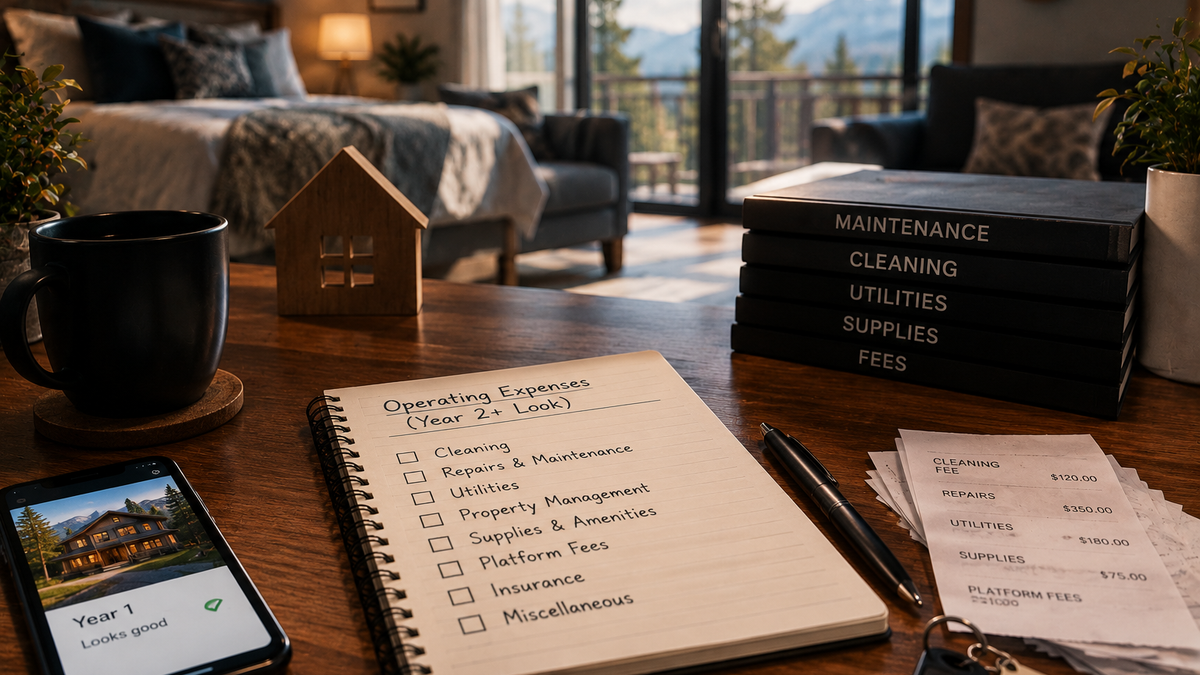
Short-Term Rental Operating Expenses: What Year One Hides
Two reserves turn a small annual loss into a large one, and neither shows up in a first-year budget. Here is the arithmetic on both.
A first-year expense budget is usually accurate and usually incomplete. It captures everything you pay in the first twelve months, which is exactly why it misses the two largest costs of owning a short-term rental.
Neither one bills you in year one. Both are certain.
Start with the list everybody gets right
Platform fees, management, utilities, insurance, property tax, supplies. Those show up on a statement, they are easy to total, and most people budget them correctly. No argument there.
Take a property bought for $420,000, producing $62,000 a year, with $37,810 of those ordinary operating costs and $25,152 of annual debt service. That leaves $24,190 of net operating income and an annual loss of $962. Tight, but survivable.
Every figure here is illustration rather than market data. Check the arithmetic; that part is real.
The two reserves a first-year budget leaves out
Both are certain, both are large, and neither sends you an invoice in the first twelve months. That combination is why they get left out.
The furniture is a cost, not a purchase
Furnishing a short-term rental gets treated as a one-off purchase in almost every budget. It behaves like a subscription.
Guests are harder on a property than tenants are. Sofas, mattresses, linens, cookware and the television all wear on a cycle measured in years, and replacing them is not optional if you want to keep the review scores that won you the bookings in the first place.
Assume $35,000 of furnishing and a five-year cycle. That is $7,000 a year you should be setting aside from the first month, and it moves our example from a $962 loss to a $7,962 loss.
Nothing about the property changed. The budget just started telling the truth.
Capital expenditure arrives on its own schedule
Roofs, heat pumps, water heaters and appliances fail when they fail. A supplies line covering restocking and small repairs absorbs none of them.
The usual approach is to reserve a percentage of property value each year. One percent is the figure most often repeated. We have not found an authoritative source behind it, so treat it as a starting point you can defend rather than a rule you can cite.
At 1% of $420,000 that is $4,200 a year. Add it to the furniture reserve and the same property, at the same revenue with the same guests, runs at $12,162 of annual loss instead of $962.
That swing is $11,200, and none of it comes from anything going wrong.
Which costs move with nights, and which move with bookings
Most expense modeling splits costs into fixed and variable against occupancy. There is a third category that matters more than it gets credit for.
Consumables, laundry wear, damage frequency and your own coordination time scale with turnovers rather than with nights sold. Thirty booked nights across ten bookings costs materially more to run than the same thirty nights across three.
This is why a shorter minimum stay is not free even when the calendar arithmetic favors it, and why two properties with identical occupancy can have quite different expense lines.
The costs that arrive in year two
- Insurance repricing. Short-term rental policies get re-rated, and one claim changes the conversation.
- Property tax reassessment. A purchase often triggers a revaluation, and the figure you underwrote may be the previous owner's.
- License and permit renewal. Usually small, occasionally not, and increasingly conditional on inspections.
- Software. Pricing tools, a lock system, a channel manager. Individually minor, collectively a line.
None of these is dramatic on its own. Together they are the difference between a budget that holds and one that drifts by a few thousand a year without anyone noticing when it started.
What to budget instead
Before you commit to a number
- Add a furniture reserve from month one. Divide your furnishing budget by the replacement cycle you actually expect, and treat the answer as a monthly cost.
- Reserve for capital expenditure separately from supplies. They are different sizes of problem and they should be different lines.
- Split your variable costs into the ones that follow nights and the ones that follow turnovers, because the second group does not appear in an occupancy model at all.
- Re-underwrite insurance and property tax for year two rather than assuming year one repeats.
- When you compare markets, remember that a revenue ranking tells you nothing about any of this, which is one of several things those lists cannot include.
The point of doing this properly is not pessimism. A deal that still works with both reserves funded is a deal you can hold through a bad year, and cash-on-cash return calculated on a complete cost base is the only version of that number worth quoting.
Put a complete cost base against a real property
Most estimates fail because the revenue line got attention and the expense line got a round number.
Start with a revenue figure you can defend, then build the expense side twice: once for year one, once for the steady state with both reserves funded. Two columns, side by side. The gap between them is the number worth arguing about.
Our Revenue Calculator handles the first column in a browser tab, no sign-up. The second column is yours to build, and the metrics glossary covers any term here you want pinned down.