
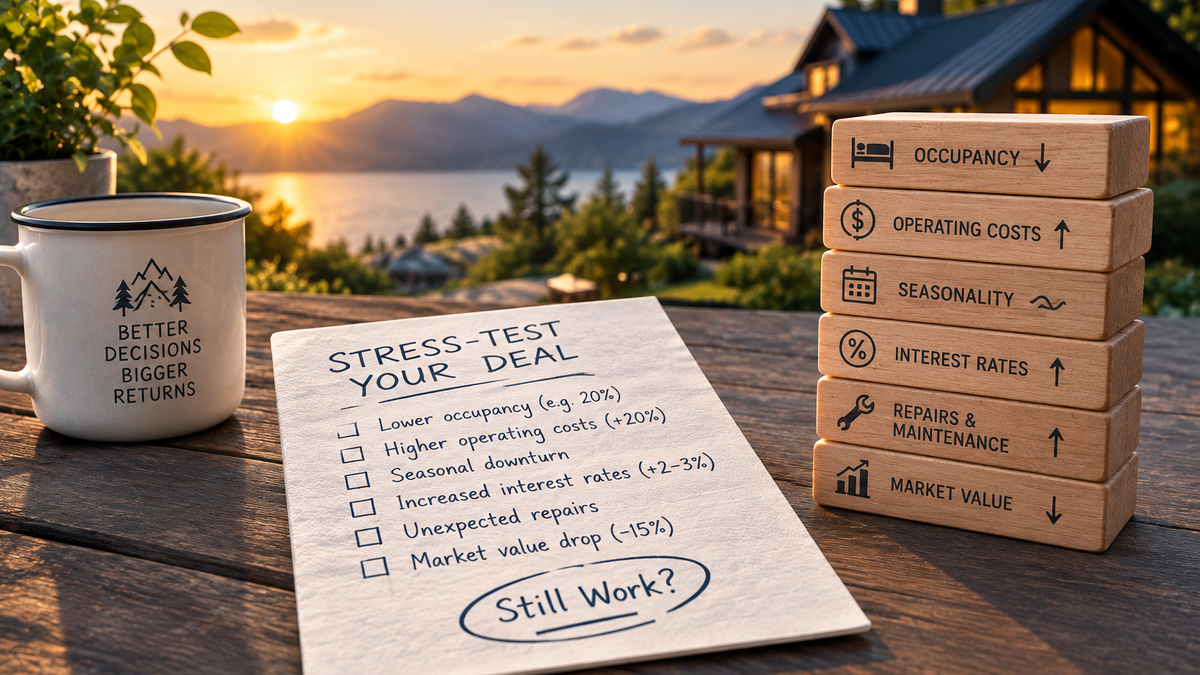
Short-Term Rental Underwriting: How to Stress Test a Deal?
Underwriting asks what breaks the deal and how long you survive it. Debt service coverage, three stress tests, and the reserve figure that decides it.
Underwriting is the part where you assume the deal goes badly and check whether you survive it. Most short-term rental analyses stop at a revenue estimate and a cash flow figure, which tells you what happens if everything goes to plan.
The numbers below continue the example from our step-by-step walkthrough, so they are illustration rather than market data. The arithmetic is real and checkable.
Start from a finished cost stack
You cannot underwrite an estimate. You need the whole picture first: purchase price, cash in, revenue estimate, every operating line, and debt service. Anything missing shows up later as a surprise rather than a risk you priced.
In the walkthrough that produced $62,000 of gross revenue, $37,810 of operating costs, and $24,190 of net operating income, against annual debt service of $25,152.
Debt service coverage, and why the lender cares first
Debt service coverage ratio is net operating income divided by annual debt service. It answers one question. Does the property produce enough to pay its own mortgage?
For this deal it is $24,190 divided by $25,152, which is 0.96. Below one means the property does not cover its own debt, and the gap comes out of your pocket every month.
Lenders set their own minimum and it varies by lender and loan product, so ask yours rather than trusting a number you read somewhere. For the sake of the example, assume this one wants 1.20. At $25,152 of debt service, that requires $30,182 of net operating income, which is roughly $6,000 more than this property produces.
That gap is the deal. Everything else is detail.
Three stress tests worth running
A rule change caps your nights
Regulation moves faster than anything else in the stack, and a city council can change it while you sleep. Model a cap that cuts your bookable nights by a quarter.
Gross revenue falls to $46,500. The platform fee drops to $7,208 and management to $9,300, but insurance, tax, utilities and supplies do not move at all, because $15,800 of your cost stack does not care how many nights you sell.
Operating costs land at $32,308. Net operating income falls to $14,192. Debt service coverage drops from 0.96 to 0.56, and the annual shortfall widens from $962 to $10,960.
Rate falls but occupancy holds
Run the same cut as a pricing problem instead of a supply one. The arithmetic is similar, but the recovery is different: you can reprice next week, whereas you cannot un-cap a city.
Ranking your stresses by how quickly you can respond matters more than ranking them by size.
Something breaks and it was not in the budget
A roof, a heat pump, a flood. Nothing in the operating stack above covers capital expenditure, and a $3,600 supplies line will not absorb an $11,000 repair. Budget it separately or it becomes a reserve problem the first time it happens.
Reserves: the figure that decides whether you hold
A deal fails when you run out of cash, not when the spreadsheet turns red. So the number that matters is how many months you can fund the shortfall.
Fixed monthly obligations here are $2,096 of debt service plus $233 insurance, $433 property tax and $350 utilities, which comes to about $3,113 a month. Six months of that is $18,678.
Now put the two together. Under the capped-nights scenario the property bleeds $10,960 a year, which is $913 a month, and $18,678 of reserves funds roughly twenty months of that.
Twenty months is a real answer. Long enough to appeal a permit decision, or to sell without panic. Four months would be a different business entirely.
What makes this harder than a long-term rental
A lease gives you a contracted number for twelve months. Short-term rental revenue is a forecast, and it varies by season, by weekend, and by how well you run the place.
That variance is the reason underwriting matters more here, and it is also why a single annual figure hides so much. If the terms above are unfamiliar, the metrics glossary defines them, and cash-on-cash return is the companion metric to coverage.
Before you commit
- Calculate debt service coverage before anything else. Below 1.0 the property does not pay its own mortgage.
- Ask your lender for their actual minimum rather than assuming a number.
- Stress the revenue line by at least a quarter and watch what happens to coverage.
- Remember that most of the cost stack is fixed. Cutting nights cuts revenue much faster than it cuts costs.
- Convert every shortfall into months of runway. That number decides whether you get to fix the problem, or sell in a hurry on somebody else's terms.
- Budget capital expenditure separately. It is not in your operating costs and it does not wait for a good year.
Put your own numbers through the same test
Build the base case first. Then cut revenue by a quarter and watch what coverage does.
The Revenue Calculator is free and needs no account, which makes it a fast way to build the base case. The stress test is arithmetic you do afterwards, and it is the half that tells you what you can survive.