
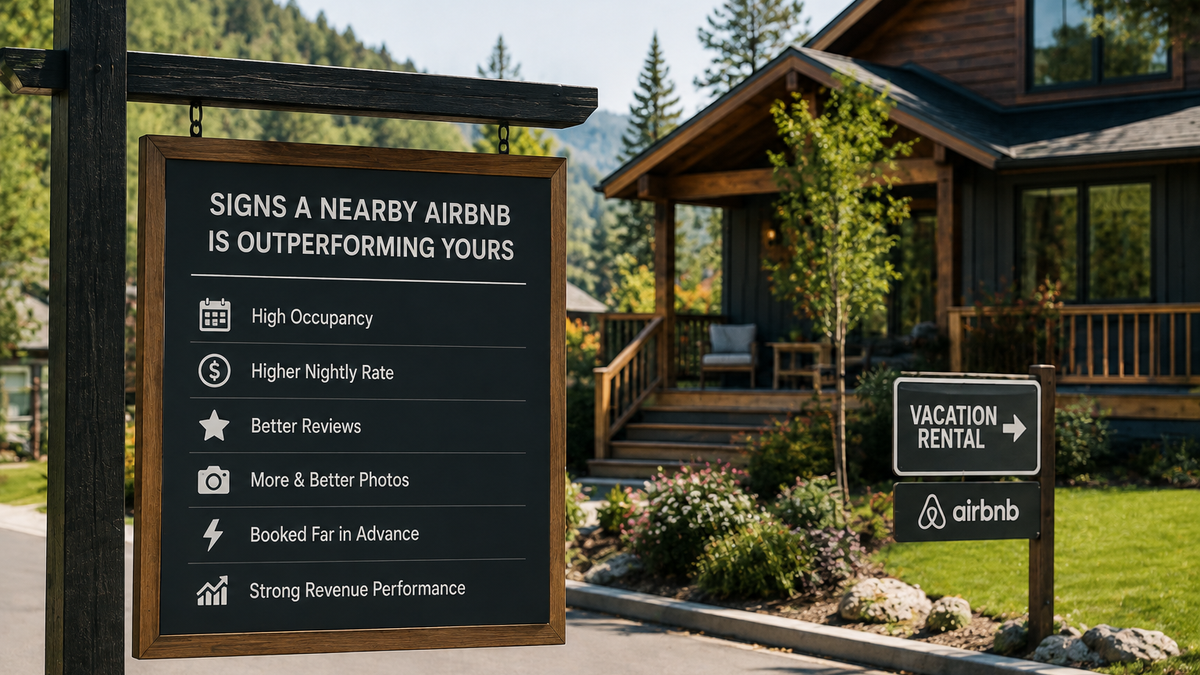
Signs a Nearby Airbnb Listing Is Outperforming Yours
The clearest sign a competing listing is beating you isn't their price or their photos. It's their calendar, and specifically how far out it fills.
The clearest sign a competing listing is beating you isn't their nightly rate, their photo count or their review score. It's how far ahead their calendar fills. A listing taking bookings ninety days out while yours fills in the last fortnight is winning, even if you both end the month at the same occupancy.
Read the calendar before you read the listing
Occupancy is a backward-looking number. It tells you what already happened. Booking pace, meaning how far in advance nights get taken, tells you what's happening now. It moves first.
Two listings can both finish October at 70% occupancy and be in completely different positions. One took its bookings in July at full rate. The other sat empty until the last two weeks and then dropped its price to fill. Same occupancy, different year entirely.
So open the calendar on a listing you consider a genuine comparable and look at the shape of it, not the total. How much of November is gone? December? If theirs is materially fuller than yours at the same distance out, that's the signal, and it's the earliest one you'll get.
What the calendar can't tell you
A caveat that matters, because plenty of advice skips it: the public calendar shows a night as unavailable without showing why. A host who has blocked a week for their own family looks identical to a host who sold it.
This is why one snapshot is close to worthless and a pattern over several weeks is not. Personal blocks tend to be lumpy and stay put. Real bookings arrive steadily and cluster on weekends. Watch the same calendar four or five times over a month and the difference becomes obvious. Tracking a listing properly is a habit rather than a single check, for exactly this reason.
Four signals that actually mean something
They hold rate on the dates you discount
Look at a specific weekend six weeks out. If they're asking more than you and their night is gone while yours is open, you don't have a pricing problem in the direction you assumed. You have a demand problem. Something about their listing is converting and yours isn't, and cutting your rate will hide that rather than fix it.
Their minimum stay is shorter than yours on the same nights
This is the most commonly missed one because it isn't a number anyone reports on. If they accept two nights on a weekend you've set to three, they're eligible for a pool of bookings you never appear in. You'll never see those searches, so it doesn't feel like a loss.
They're accumulating reviews faster than you
Compare the rate reviews arrive, not the star rating. A 4.8 with thirty reviews in six months is outperforming a 4.9 with eleven over two years, because reviews only exist after completed stays. Velocity is a proxy for volume; the rating is a proxy for experience. Both matter, but only one of them tells you who's getting booked.
Their weekday and weekend rates are further apart
A wide spread usually means someone is actively managing the calendar rather than setting a rate and leaving it. If your Tuesday and your Saturday are within a few dollars of each other and theirs aren't, you're probably underpricing your weekends, overpricing your weekdays, or both at once.
Three signals that look important and mostly aren't
Photo count. Past about twenty good photos, more photos is not a differentiator, and a competitor with sixty isn't beating you because of it.
Amenity lists. Long lists of minor amenities rarely move bookings. A real differentiator does: parking, a hot tub, workable desk space, dog-friendly without conditions attached. But those show up as specific things guests search for, not as list length.
Star rating in isolation. Covered above, and worth repeating because it's the number hosts fixate on hardest. A tenth of a point difference is noise. A large gap in review count over the same period is not.
What to do once you've confirmed it
Fix the cheapest thing first, and minimum stay is almost always the cheapest thing. It costs nothing, takes a minute, and if it was excluding you from a segment of searches the effect shows up within a booking cycle.
Then check you're comparing against the right listings at all. A four-bedroom house and a studio in the same postcode are not competitors, and neither are two similar properties if one sleeps six and the other sleeps twelve. If you're not sure which view you should be working from, the difference between looking at your whole market and looking at properties like yours is worth getting straight before you change anything. And if any of the terms above are doing more work than you'd like, the metrics glossary defines them properly.
Takeaways
- Booking pace beats occupancy, because it moves first and occupancy only confirms it later.
- One calendar snapshot can't distinguish a booked night from a blocked one. Watch the same listing repeatedly instead.
- If a comparable holds a higher rate and still sells the night you're discounting, the problem isn't your price.
- Compare how fast reviews arrive. A tenth of a point of star rating is noise.
- Check your minimum stay before anything else. It costs nothing to change, it takes about a minute, and while it's wrong it removes you from searches you never find out you missed.
Watch the listings that are beating you
Guessing which nearby listing is outperforming you is a bad use of a week. Watching three of them properly for a month is not.
Competitor Lens takes an Airbnb listing URL and returns that listing's performance data, so the comparison is something you can look at rather than something you have to infer from a calendar page.